Invasive Species: Paederia foetida, Skunk Vine
Skunk vine is an invasive perennial climbing or trailing vine that can grow to 30 ft. (9.1 m) long. Plants originate from a woody rootstock and can invade natural and disturbed areas of Hawaii and the Southeastern United States. The opposite leaves are up to 4.5 in. (11.4 cm) long, lance shaped, often lobed at the base, and on petioles up to 2.5 in. (6.4 cm) long. The stems and leaves have a strong, unpleasant odor when crushed, giving this plant its name. Flowering occurs in late summer to fall, when small, pink or lilac flowers occur in clusters, either terminally or in leaf axils. Fruit are nearly round, shiny, brown, and up to 0.3 in. (0.7 cm) wide. Skunk vine has the potential to invade a large variety of disturbed and high-quality habitats. Currently, it is widespread in Florida and in small areas of other southeastern states and Hawaii. Trailing infestations can completely cover and kill low-growing plants and small shrubs. Climbing infestations can strangle even large trees and restrict light availability to species below. Skunk vine is native to Asia and was introduced in the United States before 1897 as a potential fiber plant.
What are invasive species, and why should we be concerned about them?
Taxonomy: Scientific and Common Names for This Species
Rubiales > Rubiaceae > Paederia foetida L.
Synonym(s): stinkvine
Paederia foetida – USDA PLANTS Profile
Distribution Maps
skunk vine – The reported distribution of this invasive species across the United States (Source: Invasive Plant Atlas of the United States)
Up-to-the-minute distribution maps and why they are important
Reporting This Invasive Species
What is the best way to report the occurrence of an invasive species?
How to report an invasive species sighting to EDDMapS – Early Detection & Distribution Mapping System
EDDMapS – Report an invasive species to EDDMapS.
County Extension Offices – Find your county Extension office on this map provided by USDA.
How to Identify
This invasive species can be identified by looking for the characteristics described in the paragraphs that follow.
Vine
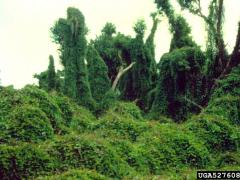
Skunk vine is a perennial climbing or trailing vine that can grow to 30 ft. (9.1 m) long.
 |
 |
| Ken A. Langeland, University of Florida, bugwood.org | Tony Pernas, USDI National Park Service, bugwood.org |
Foliage
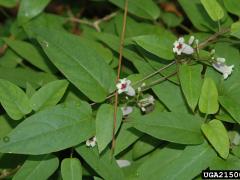
The opposite leaves are up to 4.5 in. (11.4 cm) long, lance shaped, often lobed at the base, and on petioles up to 2.5 in. (6.4 cm) long. The stems and leaves have a strong, unpleasant odor when crushed, giving this plant its name.
 |
 |
| Chris Evans, River to River CWMA, bugwood.org | Chris Evans, River to River CWMA, bugwood.org |
Flower
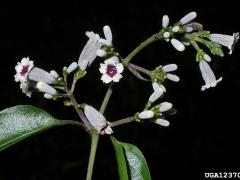
Flowering occurs in late summer to fall, when small, pink or lilac flowers occur in clusters, either terminally or in leaf axils.
|
|
 |
| Gerald D. Carr, Carr Botanical Consultation, bugwood.org | Peggy Greb, USDA Agricultural Research Service, bugwood.org |
Fruit
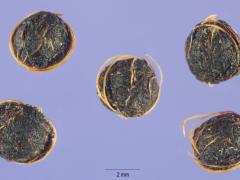
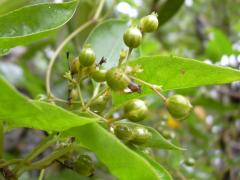
Fruit are nearly round, shiny, brown, and up to 0.3 in. (0.7 cm) wide.
 |
 |
| Steve Hurst, USDA NRCS PLANTS Database, bugwood.org |
Forest and Kim Starr, Starr Environmental, bugwood.org
|
Additional Images for Skunk Vine
skunk vine – Images at invasive.org
Learning Resources for Skunk Vine
Additional Information, Biology, Control and Management Resources
Control and management recommendations vary according to individual circumstances. Location, habitat, weather, and a variety of other conditions are factors that help determine the best treatment choice. To find the safest and most effective treatment for your situation, consult your state’s land-grant institution. If you will use chemicals as part of the control process, always refer to the product label.
United States Land Grant University System – Find your Land Grant University’s College of Agriculture, University Cooperative Extension Service, or other related partner on this map provided by USDA.
Invasive Species Management Plans for Florida – University of Florida, Center for Aquatic and Invasive Plants
Biological Control of Invasive Plants in the Eastern United States – USDA Forest Service
Identification and Biology of Nonnative Plants in Florida’s Natural Areas – University of Florida
Fire Effects Information System – USDA Forest Service
Pacific Island Ecosystems at Risk (PIER) – USDA Forest Service
Global Invasive Species Database – Invasive Species Specialist Group (ISSG)